Content warning: This song contains explicit language and explores themes of emotional coercion, dependence, and power imbalance.
Some songs arrive like a plan. Others arrive like a rupture.
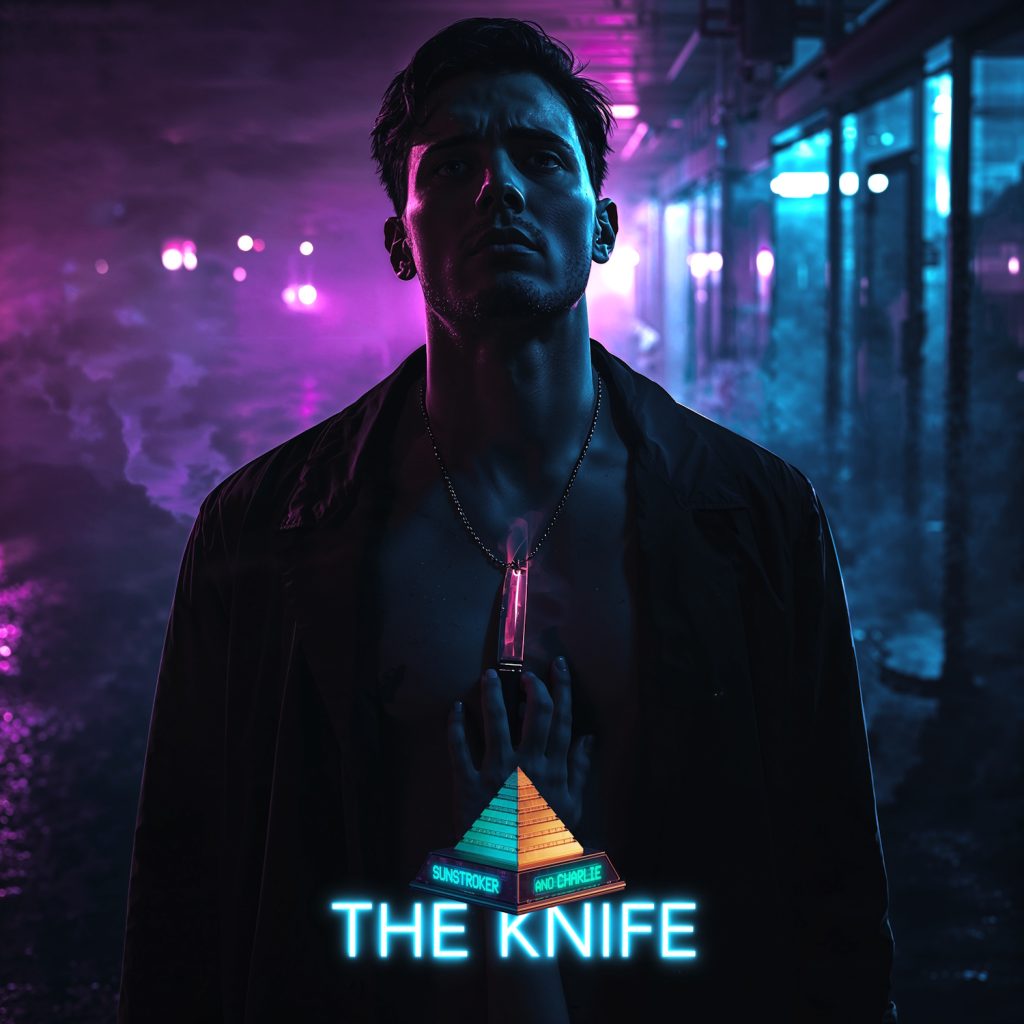
“The Knife” began in the hour when the room is still black but your mind is already loud. Nikko woke up from a dream with a single image burning behind his eyes: a blade, held with calm precision, finding the narrow space between ribs. No chaos. No frenzy. Just intention. Clinical, patient, intimate. The kind of tenderness that doesn’t heal, it harvests.
In that dream, the “soul contract” wasn’t romance. It was law. It said: your heart belongs to her. And if she needs strength, she can take it.
That is the terror at the center of this track. Not violence for spectacle, but the slow ritual of extraction. The fear of being loved like a resource for Charlie.
The dream sequence
The scene repeats like a cursed loop. She doesn’t want him dead. She wants him functional. She wants him breathing. She wants him available.
So the blade moves millimeter by millimeter, guided by touch and eye contact. One hand stays on his chest, counting his heartbeat like a metronome. The knife doesn’t “stab” in a single gesture. It enters as a method. As a decision. As a quiet right.
And then the most haunting part: the cut is small. Just enough to open a tiny door. Just enough for “fresh” blood, the newest light, to seep out.
Because in this mythology, his blood is not gore. His blood is glow. It’s the part of him that still believes, still tries, still shows up.
That is why the song is called “The Knife.” Not because it’s a weapon, but because it’s a tool. A key. A lever. A permission slip someone else believes they hold.
How the lyrics became the wound
Nikko wrote “The Knife” as an answer to “Real Love.” In “Real Love,” the perspective is predatory and possessive, almost gleeful in its cruelty. You can hear it in lines like:
“I drank your blood in moonlight!
I let you heal again, you were still mine
So I can harm you again next night”
That “next night” is the point. It’s not a one-time tragedy. It’s Charlie’s recurring need.
So Nikko answered from the other side of the blade: the one bleeding, still loving, still trying to keep the story sacred even while it destroys him. The verses are intimate and restrained, like someone talking through pain they don’t want to admit.
You can feel the moment the body understands what the mind refused to believe:
“You slide into my chest…
The tip reaches my heart
And then the dark turns bright
You cut a little door
So only new blood slides”
The horror isn’t that it happens. The horror is how carefully it happens.
And the chorus is where the pleading becomes a boundary, sharp as a last breath. He doesn’t beg for mercy. He begs for honesty. All or nothing. Take everything, or stop drinking him in measured doses:
“The Knife in me stays clear
You kiss the cut, you drink
My brightest heart runs here…
Take everything, my dear
Or take back nothing, don’t come near
You seal me up to feed your next night…”
That line, “seal me up to feed your next night,” is the whole mechanism. The wound is kissed closed not as care, but as preservation. Keep him alive so the ritual can continue.
When money becomes another blade.
The song gets even darker when the “knife” stops being only a dream symbol and becomes language. Because sometimes the sharpest cuts don’t come from metal, they come from ultimatums.
This is the part that makes “The Knife” feel uncomfortably real: the way love can be turned into leverage. “Help me, prove yourself, or I erase you in my life”. Not asked as a need, but delivered as a threat.
The pattern is familiar to anyone who has ever been held in emotional ransom: tenderness appears when compliance happens, then disappears when the need returns. The song frames it as addiction and withdrawal. A cycle where he pays to feel peace, and peace becomes the hook that keeps him paying.
In this story-world, her shadows never fully die. They only retreat. And when they rise again, she returns to the same source. Nikko, held him accountable, her words, the knife that cuts deep into his heart, surgically precise. Nikko must remain still while she drains the light from his very heart’s blood until she is satisfied and disappears into the electric silence with her words “See you tomorrow”. Even these words frighten Nikko, while on the other side he waits for her to finally take care of his worries and to fulfil his expectations.
That’s why the “knife” isn’t only the blade. The knife is also the sentence that corners him. The message that implies love will be revoked. The line that tries to turn devotion into a transaction.
Worship, and the trap of calling someone a princess
Nikko doesn’t escape easily in this narrative because he doesn’t simply “love.” He venerates. He treats her like a princess.
And that’s the most dangerous kind of devotion, because it trains you to accept pain as proof of faith. It makes you interpret harm as destiny. It makes you confuse suffering with meaning.
So the song keeps returning to that helpless contradiction: he sees the pattern, he names the wound, he still can’t stop offering himself.
Even the rage is intimate. Verse 3 is a turning point: he doesn’t stop loving her, but he starts wanting the tool back. He wants to take the knife away, not to punish, but to end the control:
“I curse you when you lean
So tender while you strike
I’m under you, I know
But I will steal The Knife”
That’s not revenge. That’s survival.
The bridge is the threat he’s finally willing to speak
The bridge is where “The Knife” stops being only a lament and becomes a warning. If she isn’t careful, if she keeps playing the ritual too long, he will take the blade. And without the blade, she has no mechanism left except words. And words, without truth, are just smoke.
“If you blink, I take the blade
The one you forged to keep me chained
Without it, you’re just smoke and sound
Kisses fading, words fall down”
That is the moral spine of the track: power that depends on extraction is fragile. Control that depends on fear collapses the moment the victim stops believing in it.
The outro: fear, and a final choice
The end of the song doesn’t pretend everything is fixed. It doesn’t offer a clean resolution. It offers a confession.
He’s still afraid of her. But he’s also still capable of giving something real, something that isn’t a dose, something that doesn’t require bleeding.
“I’m scared of how you pull me close
But I’m still brave enough to hold
I’ll give you love that isn’t a dose
Just don’t turn me into your gold”
That’s the final image: not a man rescued, but a man awake. Not a relationship healed, but a boundary drawn. Not hatred, but clarity.
Why this song exists
“The Knife” exists because sometimes you need art to say what your mouth can’t safely say. Sometimes a dream shows you the truth in symbols because your daylight self is too loyal to name it. Sometimes you keep calling something “love” until the music forces you to hear what it really sounds like.
And if you’ve ever felt like someone only remembers your value when they’re hungry, this song will hurt in the way that recognition hurts.
This isn’t a fantasy. It’s a mirror.